Learn›What ABV Means
What ABV Means
ABV — "alcohol by volume" — is the number on every bottle telling you how strong it is. Here's what it means for your glass.
The Idea
The Idea
ABV is simply the percentage of the liquid that's pure alcohol. A 40% whisky is 40% alcohol, the rest water and flavour. "Proof" is an older measure — in the US, proof is double the ABV (40% = 80 proof). Cask-strength spirits (often 50–60%+) are bottled undiluted; most spirits are cut with water down to a standard strength.
The Key Points
The Key Points
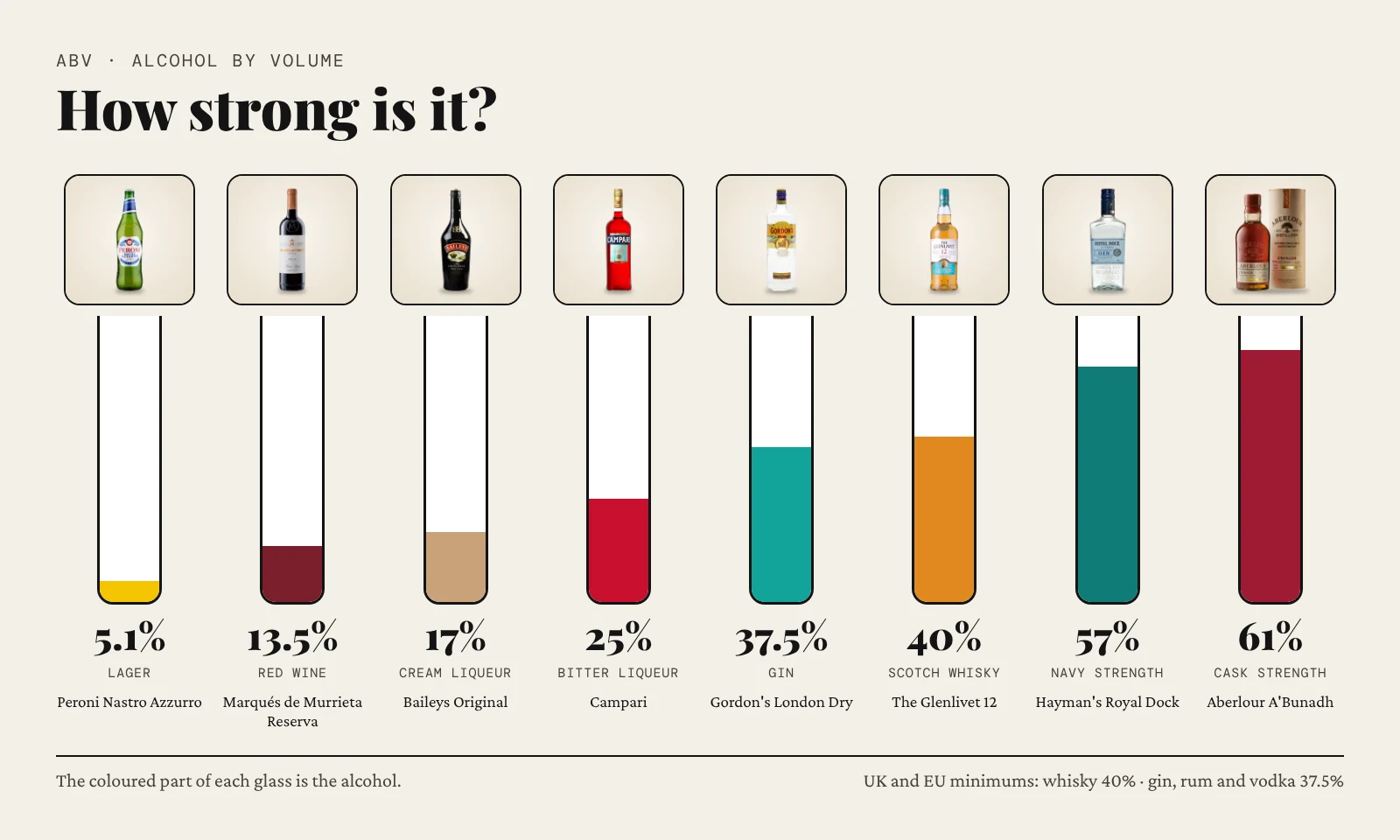
- Most spirits sit at 37.5–40% (in the UK and EU, whisky must be at least 40%, gin, rum and vodka at least 37.5%).
- Liqueurs are lower, usually 15–30%.
- Cask / navy strength run high, 55%+.
- Wine is ~11–15%, beer ~4–6%.
- Higher ABV isn't "better" — but it carries more flavour and rewards a drop of water.
How to Use It
How to Use It
With strong spirits, a few drops of water "open up" the aroma by releasing compounds the alcohol holds tight. Taste before and after — the simplest upgrade there is.
Fun Facts
Fun Facts
- The story goes that "proof" comes from sailors testing rum by soaking gunpowder in it — if it still lit, that was proof it wasn't watered down.
- Navy strength (57%) is said to be the level at which spirit-soaked gunpowder still lights.
- In the UK and EU, whisky must be at least 40% and gin at least 37.5%.
- Adding water doesn't weaken flavour — it often amplifies it.